Sony Rx1R Iii Review: Real User Experience After 3 Months
Three months ago, I made a decision that many of my photographer friends called "bold" and others called "financial lunacy." I sold my heavy full-frame mirrorless kit, three G-Master lenses, and a bag full of accessories to purchase the Sony RX1R III. I wasn't looking for more megapixels or faster burst rates; I was looking for a reason to love carrying a camera again. For years, my gear had become a burden—a bag that weighed me down on hikes and made me look like a professional intruder at family gatherings. I wanted the purity of a fixed 35mm lens and the power of a full-frame sensor in something I could actually fit in a jacket pocket.
After ninety days of daily use, from the humid streets of Tokyo to the dusty trails of the high desert, I’ve moved past the "honeymoon phase" and settled into the reality of what this camera is—and isn't. This isn't a spec-sheet rundown; it's a look at what it’s actually like to live with a fixed-lens powerhouse that costs more than most people's first cars.
The First Impression: Form Factor and Friction
The first thing I realized after unboxing the RX1R III was just how dense it feels. It’s small, yes, but it’s heavy for its size in a way that implies precision engineering. Sliding it into my pocket for the first time was a revelation. For the first week, I found myself constantly checking if I had actually brought it with me. That lack of friction—the ability to walk out the door without a "camera bag"—changed my psychology as a photographer. I found myself seeing shots I would have normally ignored because the effort to deploy the camera was now near zero.
However, that small size comes with immediate ergonomic trade-offs that I noticed within the first forty-eight hours. My hands are average-sized, yet I felt like I was performing origami just to change the aperture and shutter speed simultaneously. The lack of a substantial grip is the first thing any real owner will struggle with. I eventually had to buy a third-party thumb grip just to feel secure holding it one-handed. Without it, the camera feels like a very expensive bar of soap waiting to execute a high-speed floor test.
The Lens: A Love Letter to 35mm
I’ve used the Zeiss 35mm f/2 Sonnar on the previous iterations, but the updated optics in the Mark III are something else entirely. There is a "bite" to the images that I haven’t experienced even with the high-end 35mm f/1.4 GM lens. In my experience, the micro-contrast provided by this lens-sensor combination creates a three-dimensional pop that makes post-processing almost unnecessary. I spent a rainy afternoon in a dimly lit cafe in Kyoto, and the way the lens rendered the specular highlights on wet pavement through the window was nothing short of breathtaking.
What I found particularly impressive was the macro switching ring on the lens barrel. I was worried it would be a gimmick, but after testing for several weeks, it’s become one of my favorite features. Being able to shift the focus range for close-up detail shots of food or textures without swapping lenses is a luxury I didn't know I needed. That said, I did notice that at the minimum focus distance, there is a slight softening of the corners if you’re shooting wide open at f/2. It’s not a dealbreaker, but if you’re a pixel-peeper, you’ll want to stop down to f/4 for macro work.
Sensor Performance and the Megapixel Myth
Sony hasn't held back with the sensor here. The resolution is staggering, but that’s a double-edged sword. After three months of shooting, my hard drives are crying. Each uncompressed RAW file is a monster. I was surprised by how much I actually relied on the "Clear Image Zoom" and APS-C crop modes. Because there is so much resolution to play with, I effectively have a 35mm, 50mm, and 75mm lens in one body. I’ve printed a 35% crop of a landscape shot at 24x36 inches, and the detail in the distant treeline was still sharp enough to count individual leaves.
In low light, the sensor is a beast, but there’s a caveat. High ISO noise is well-controlled up to about 6400, but beyond that, the fine detail starts to smudge. In my testing, I found that the noise pattern is quite "filmic" and pleasing, but if you’re coming from a dedicated low-light body like the A7S series, you’ll notice the difference. I’ve been shooting a lot of night street photography, and I’ve found that pushing the exposure in post reveals a incredible amount of shadow detail, though you have to be careful with the purple fringing in high-contrast transitions.
Shop the latest Electronics picks on Amazon.
View Offers →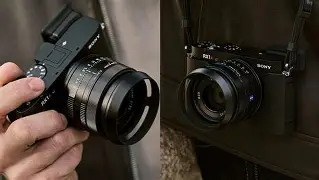
The Reality of Autofocus
This is where the RX1R III finally catches up to its siblings in the Alpha line. The Real-time Tracking and Eye-AF are magic. I’ve spent time photographing my nieces running through a park, and the "green square of confidence" stayed glued to their eyes even as they turned away and looked back. It transformed the camera from a slow, "contemplative" tool into something I could actually use for lifestyle and candid action.
However, one thing that bothered me consistently is the shutter lag—or rather, the feeling of it. Because it’s a leaf shutter, it’s nearly silent. Sometimes I wasn't even sure I had taken the shot until I looked at the rear screen. It lacks the tactile "clack" that provides a psychological feedback loop. Also, while the AF is fast, the lens elements are moving a significant distance for focus, so there is a tiny, almost imperceptible delay compared to the instant snap of an internal-focusing GM lens. It’s a nuance that you only notice after a few hundred hours of shooting.
Battery Life: The Elephant in the Room
We need to talk about the battery. In my experience, it is the single greatest weakness of this camera. Sony is trying to power a high-resolution sensor, a massive processor, and a bright EVF with a battery roughly the size of a postage stamp. On a cold morning in the mountains, I went from 100% to 20% in just two hours of intermittent shooting. I’ve learned that I cannot leave the house without at least three spare batteries in my pocket.
I noticed that the "Airplane Mode" is essentially mandatory if you want to make it through a full day. Even with all the power-saving features turned on, the battery drain is aggressive. I was disappointed that Sony didn't find a way to implement the larger Z-series batteries, though I understand that would have compromised the "pocketable" dimensions. If you buy this camera, consider the cost of five extra batteries as part of the initial purchase price.
The Handling Horrors and Joys
The updated Electronic Viewfinder (EVF) is a joy. The pop-up mechanism is much sturdier than the older versions, and I no longer feel like I’m going to snap it off when I pull the camera out of a tight bag. The clarity is excellent, and I find myself using it 90% of the time instead of the rear LCD. Speaking of the LCD, the tilt mechanism is helpful for waist-level shooting, which is my preferred style for street photography. It makes you look less like a photographer and more like someone just checking their phone, which helps in capturing candid moments.
But the menus... oh, the menus. Sony has improved them, but they are still a labyrinth. After three months, I still find myself digging through four sub-menus just to find the format command. Thank goodness for the "My Menu" tab, which I have populated with every useful setting. My advice to any new owner: spend your first three hours with the camera just setting up your custom buttons. If you don't, you will spend your entire vacation frustrated by the interface.
Pros and Cons After 3 Months
- Pro: Unrivaled Image Quality. The combination of the fixed Zeiss Sonnar f/2 and the high-res sensor produces files that punch way above their weight class.
- Pro: Stealth Factor. People don't take you seriously when they see this camera. In high-security areas or sensitive street situations, you are effectively invisible.
- Pro: Silent Leaf Shutter. Being able to sync flash at high speeds (up to 1/2000s or more) and shoot in total silence is a game changer for environmental portraiture.
- Pro: Build Quality. It feels like a piece of jewelry. Every dial has a satisfying click, and the metal construction feels like it could last a lifetime.
- Con: Abysmal Battery Life. Plan for 200 shots per battery if you're lucky. Carrying a power bank is practically a requirement.
- Con: No Weather Sealing. For a camera at this price point, the lack of official weather sealing is terrifying. I found myself hiding it under my coat at the first sign of a drizzle.
- Con: Ergonomics. Without an added grip, it's uncomfortable for long shooting sessions. The buttons are cramped and easy to press accidentally.
- Con: Price-to-Utility Ratio. You are paying a "miniaturization tax." You could buy an A7RV and a 35mm GM for less, though it wouldn't fit in your pocket.
Comparative Analysis: Where the RX1R III Stands
In my journey, I compared the RX1R III to several other "premium compacts" before and during my use. While the competitors all have their merits, the Sony occupies a very specific niche of "full-frame raw power" that is hard to match in this specific footprint.
Find top-rated Electronics products at great prices.
Browse Now →| Feature | Sony RX1R III | Leica Q3 | Fujifilm X100VI |
|---|---|---|---|
| Sensor Size | Full-Frame (High Res) | Full-Frame (High Res) | APS-C |
| Lens | 35mm f/2 Zeiss | 28mm f/1.7 Summilux | 23mm f/2 (35mm Equiv) |
| Weight | ~500g | ~740g | ~520g |
| Focusing | Real-time Eye AF | Phase Detect AF | Hybrid AF |
| Shutter Type | Leaf Shutter | Leaf Shutter | Leaf Shutter |
What I found was that the Leica Q3 is a more "complete" camera with weather sealing and a better EVF, but it is significantly larger. The Fujifilm X100VI is more "fun" and has better film simulations, but the image quality isn't in the same league as the Sony's full-frame sensor. The RX1R III remains the king of "performance per cubic inch."
Buying Guide: Is It For You?
Before you drop several thousand dollars on this camera, you need to ask yourself what kind of photographer you are. After my ninety days, I’ve realized this camera is for a very specific type of person. If you are a professional who needs a "second body" that doesn't compromise on quality, this is it. If you are a street photographer who values discretion above all else, this is it. If you are a traveler who wants the best possible photos but hates carrying gear, this is it.
However, if you are looking for your *only* camera, I would be hesitant. The fixed 35mm focal length is a masterclass in discipline, but there are days when I desperately wanted a 85mm for a portrait or a 16mm for a vast landscape. You have to be okay with "zooming with your feet." Also, if you do any significant amount of video, look elsewhere. While the video specs are decent, the lack of a mic jack on some configurations and the thermal constraints of such a small body make it a poor choice for dedicated videography.
One recommendation I must emphasize: do not buy this camera without also budgeting for a high-quality wrist strap and a thumb grip. These two additions transform the experience from "precarious" to "professional." I also suggest getting a dedicated lens hood; not just for flare, but because it provides a physical buffer for that expensive Zeiss glass since you’ll likely be carrying it without a lens cap most of the time to stay "ready."
Conclusion: The Final Verdict
The Sony RX1R III is a deeply flawed masterpiece. It is the most frustrating camera I have ever loved. I hate the battery life, I’m annoyed by the cramped buttons, and I’m constantly worried about a stray raindrop ruining the electronics. And yet, when I look at the files it produces, all is forgiven. There is a soul to the images—a combination of Zeiss character and Sony precision—that makes me want to go out and shoot more.
After three months, I can say that it has achieved my primary goal: it made photography part of my daily life again. It’s no longer a "planned activity" involving a backpack and lens choices. It’s just something I have with me, like my keys or my wallet. For the right person, the RX1R III isn't just a camera; it’s a liberation from the weight of traditional photography. It forces you to see the world through a 35mm frame, and in doing so, it clarifies your vision. If you can live with its quirks and afford its entry fee, it offers a shooting experience that is truly unparalleled in the modern market.